In a day of making endless distinctions-totally blind vs. partially sighted, cane user vs. dog handler, working blind vs. the seventy percent-one touchstone remains that many people think of when talking blindness. That’s the use of braille to write. Even if someone who is sighted doesn’t know a friend or relative who’s blind, they’ve probably associated the bumpy six dot cell with those who can’t see.
I remember learning to read my letters and numbers first in kendergarten, then adding more complex contractions and how to write braille in the next couple years. And, wow, did my world open up! Just like my friends who went to public school, I could read little books about the Bernstein Bears, Charlotte’s Web, and the Hardy Boys Series all at my fingertips.
Yet, the biggest thrill in my young life was receiving my first braille Bible, the tried and true Revised Standard Version when I was in second grade. I had just rode home from the Indiana School for the Blind with others who lived in Anderson, Indiana. Dad picked me up from the drop-off point outside Anderson High School and told me there was a big present waiting for me at home. Of course, my little brain was more focused on the fact my folks, my brother, and I were going to take the weekend down in Cincinnati. The Reds were playing the Dodgers that night and I just couldn’t wait to be in the same ballpark with Johnny Bench, hoping he’d hit a homer.
Well, when I walked into my house’s family room, Mom showed me the boxes Dad had mentioned. Like a kid on Christmas morning, I tore into those things as fast as I could and, before I knew it, I was reading from Exodus 3 about Moses at the burning bush.
Of course, as technology has changed over the years, my use of computers, online study resources, and other ways of reading have become my primary modus operendi. But, braille still remains for me, especially for writing little notes to myself or reading a few magazines I get from Lutheran Braille Workers. http://www.lbwinc.org I still maintain my rapid speed because I never want to lose my abilities with reading and writing Braille.
Check out the accompanying article from Vision Aware. You’ll read a bunch of other encouraging testimonies of how braille affects people’s lives.
This month, we who are blind and those who are sighted observe glaucoma awareness month. One of the biggest tells that you may have this eye condition is high pressure that builds up to the point of causing migraines, blurry vision and a gradual loss of peripheral sight.
While the disease does discriminate between various ethnic groups (see the attached article), many people like myself get it when we’re very young, especially when it is accompanied by another disease. In my case, Coates disease (not communicable, by the way), dedetached my retinas from my optic nerves. In conjunction with cataracts, glaucoma made my eyes feel as if I were weeping jelly between the ages of four to nine.
The preventative measures which the article mentions aren’t cure-alls. They, however, increase the chance of thwarting the full impact glaucoma can have.
The readings for the fourth Sunday after Epiphany are Jer. 1:4-10, 17:19; 1 Cor. 12:12-31 (13:1-13); and Luke 4:31-44.
We often feel a lack of confidence when telling about the great Gospel of Jesus Christ. Some friends write us off as following mere superstition. Others will unfriend us on social media. Still, our Lord who was rejected in Nazareth-His home town-and then welcomed elsewhere, He has given us His Word to speak with friends and family. He’s called us to the very salvation of which we speak and in which we live.
Sports are a big deal for many people who are blind. And we do say we are watching hoops, football, baseball, swimming and so forth when ESPN or another channel is showing on the TV.
But, along with watching sports that most folks know about, many blind people play sports uniquely invented for people who can’t see. Check out this video about goalball. It’s fun, it’s fast, and full of action!
It’s been too long since I’ve blogged here. Hence, with discussing my forthcoming novel (previous post), I am resuming the journey.
What can you expect? The world that most of us who are blind experience often overlaps with mainstream, workaday society. Hence, the news, stories, and tips I share here will show how blindness culture interacts with the world at large. Sometimes, this will involve discussions of politics, sports, and other angles on current events. We will address mobility issues ranging from guide dog travel to canes, asking the sighted public, for help-when and when not to.
My hope is to publish short, often flash, fiction from time to time which will show you the further adventures taken by people in the fictional town of Bryant, Nebraska, where my novel, Jag, takes place.
Eventually, I’d love to build in a podcast which can expand on posts by covering blindness news, tips, and trends more in depth than a short, written post can do.
Finally, being a blind Christian myself of the Lutheran variety, I plan to discuss the upcoming Sunday’s readings and apply them to our lives.
So the journey of being boldly blind resumes. I look forward to you joining me on it.
When Breanna Conley enters Gerhard College as a freshman, she finds her academic advisor struggling with his diminishing sight. Thanks to her dad being totally blind and a background as a puppy raiser for California Guide Dogs, Breanna is called on by fellow students and faculty alike to build bridges to better help their professor and colleague cope with his new normal.
Breanna must reach deeper than her firsthand experiences. Trusting in Christ Jesus whose thoughts and ways are much higher than ours, she walks the often confusing path between a freshman’s life in college, her parents’ recent divorce, and the resources that may open doors to her professor’s healing.
In a vision, God commanded Ezekiel to cry for breath to enter dry bones scattered across the valley floor. By bringing those bones to life by His Spirit, God promised to raise His people from death to life.
Likewise, when raising Lazarus from his death due to sickness, Jesus shows Himself as Lord over life and death. By this sign, He points to His own death for our sins and His own resurrection by which we are saved.
In Him, we are turned from death to life. For we know that the Spirit, by Whom the Father raised Jesus from the dead, will bring us—body and soul—from the grave to live forever.
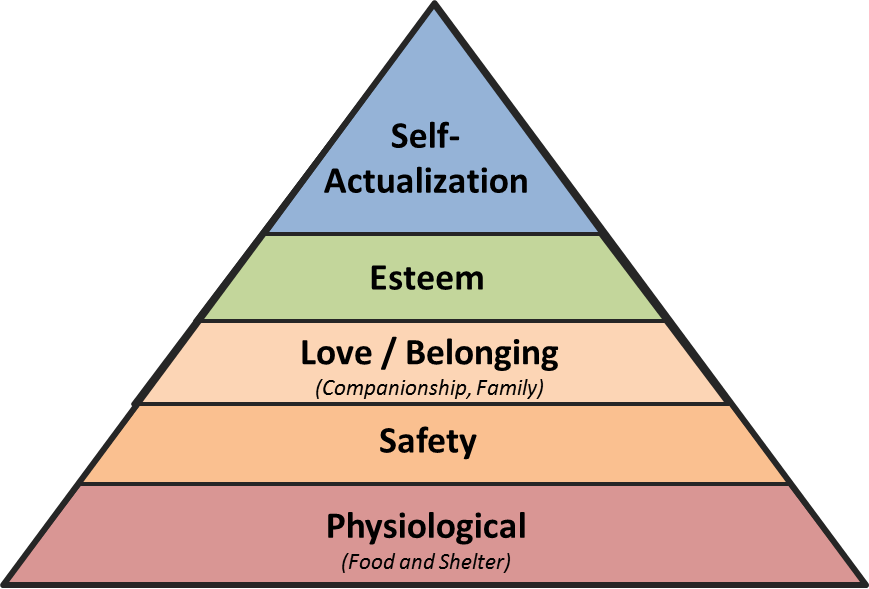
Maslow’s Hierarchy of Needs: Physiological, Safety, Love and Belonging, Esteem, and Self-Actualization
As more and more States implement shelter-in-place mandates, many of us are asking what makes the difference between essential and nonessential services. Most States agree that food, home, medical attention and jobs that benefit everyone’s need for survival. Maybe you’re like me, seeing a correspondence between Maslow’s hierarchy of needs and the bare necessities available to us during the coronavirus’s spread.
We who brave contagion to run errands see restaurants shuttered, athletic events canceled, and churches closed. Why churches? In the event of plague or pestilence, there are sanitation controls and protocols in place to limit the spread of disease in public places. In most states, church buildings are included alongside schools with regard to their potential as breeding grounds for the contagion and, as I recently learned, in Indiana, the power to administer these codes and protocols is entrusted to individual County Health Commissioners.
Were these buildings closed during the SARS outbreak in 2002/2003? No. Since the epidemic didn’t register much contagion in the United States, the need for closure was less apparent. Even in 2009 when the Swine Flu infected millions and took the lives of twelve thousand, the threat didn’t pose much of a risk for us. Vaccines and other treatments became available in short order and most people were spared the economic downturn while our nation was still bouncing back from the economic crisis of 2008.
Two factors make COVID-19 more deadly than previous epidemics. First, it’s easy to catch and the full extent of how it’s transmitted remains unknown. Can we get sick by touching someone? Most likely. Can we catch the virus by breathing the same air as others around us? We don’t yet know, but we suspect so.
The second factor is how fast its effects take hold. Yes, its incubation period may be up to fourteen days. Witness the time length Senator Ted Cruz self-quarantined after contact with an infected participant at the CPAC conference. Still, when a person gets sick, he or she most often develops a quick high fever, shortness of breath, and frequent dry coughing.
Those symptoms are certainly nothing to play with. COVID-19 can cause someone to develop pneumonia or other severe respiratory illness, which may last for years. It is most prevalent in people having compromised immune systems due to underlying conditions, but we are beginning to see many more younger folks succumbing to the disease.
And that’s where the rubber hit the road for many state departments of health which oversee the occupation and operation of public buildings under their jurisdiction. Following the Centers for Disease Control (CDC) guidelines, they ordered crowds first to be no larger than fifty in these locations, then ten, before ultimately mandating closure. Indiana Code 16-19-3-1-10 reads as follows: “The State Department may order all schools and churches closed and forbid public gatherings when considered necessary to prevent and stop epidemics.”
As States bordering Indiana began enacting shelter-in-place mandates these past couple of weeks, we knew our time was coming. First individual schools were closed by principals, then entire school districts shut down by order of superintendents or boards of education. After that it was other, more public locations such as bars, restaurants, theaters, malls, and even parks. Then, what many of us considered an untimely, abrupt punch to Fort Wayne’s Christian community came at 5:30 PM this past Saturday, March 21 when the Allen County Health Commissioner issued an order suspending church services. The order was ambiguously worded such that it was unclear whether no church was permitted to have any in-person services at all or if in-person services were permitted so long as the total number gathered did not exceed ten people (including the pastors). Most churches understood it to mean that no in-person services were permissible (something that has since been clarified by the Department of Health) and their leadership was left in confused scramblings to announce these changes to their staff and parishioners at the eleventh hour. The next morning, dozens of congregations encouraged their members to worship online, some congregations for the first time.
What follows here is a letter I wrote to the Fort Wayne Journal-Gazette’s editor voicing the frustrations of many who had mere hours to prepare for the upcoming shut-down. Even for those congregations who already offered live feeds for online viewing or recorded sermons for later use were shocked at the swift action taken by Allen County’s Health Commissioner.
Dear Editor:
The cancellation of all church services in Allen County by the Health Commissioner, Dr. Deborah McMahan, caught many churchgoers and members of the clergy off guard. Since the mandate came to most of our attention at about 5:30 on Saturday evening, March 21, many congregations had only a few hours to digest its impact before Sunday morning.
Many church leaders had planned for worship services and activities through Holy Week (April 5-11) so the abrupt stoppage of plans through April 11 left us perplexed at how pastors will care for members of their congregations. How could worship, including the celebration of Holy Communion, take place at all? At this late hour, how would worship leaders acquire soft- or hardware for broadcasting live services? Lay leaders are still figuring out the financial and operational toll this cancellation of church activities will take.
The closure of bars’ and restaurants’ in-person service along with other “nonessential” activities of public life (e.g. clubs, athletic competitions, and concerts) have impressed upon us all the need to practice social distancing. “Wash your hands,” has become our mantra promoting mindfulness of health and hygiene.
With that said, people of faith desire to worship together while complying with the standards befitting our community’s health and safety. As such, we acknowledge Dr. McMahan’s authority under Indiana Code 16-19-3-10 to mandate the closure of schools and church buildings during a pandemic’s rapid spread, but it behooves Dr. McMahan to gather church leaders for a public hearing (IC 16-19-3-17) so that the Health Commission’s concern and congregational accommodations may be cooperatively addressed some days prior to any action being taken. Such a hearing would serve to bring Church and State, as it were, into a partnership rather than an adversarial relationship. Churches, after all, stand central to congregational life and community. Furthermore, they are beacons of refuge for members of the community at large who benefit from their food pantries, counseling, and community outreach.
For the sake of public welfare, Dr. McMahan should provide an explanation for her broad-sweeping mandate to cancel church services and close their buildings for the next three weeks. I am sure many pastors and lay leaders wish to speak with her so that we may continue religious services and human care while observing the CDC’s recommendations for curbing the COVID-19 pandemic’s spread.
Sincerely,
David Rosenkoetter
What’s At Stake?
With no threat against the First Amendment to the U.S. Constitution, citizens recognized that no one was keeping our pastors from preaching. No blasphemy laws were being imposed. What mattered was the lack of a hearing for local religious leaders. Little or no communication came from the Allen County Health Commissioner’s office before the last-minute mandate. Of course suspicions were raised. What would happen for those people arriving the next morning without hearing of the closure ahead of time? What would become of the food kitchens and pantries many congregations offer people who are homeless? And what about the congregational life together—worship, planned community outreach, and so forth?
As the late chess grandmaster Bobby Fischer said, “There’s a time to punch and a time to duck.” For now we wait for the coming weeks, prepared to view recorded services of prayer and preaching, Matins, or Vespers led by pastors in empty sanctuaries. May God—Father, Son, and Holy Spirit—guide our discernment and grant us sound reasoning in these matters while the COVID-19 pandemic lasts.
Tokyo’s “One Moment in Time” Delayed for a Later Moment
Picture yourself after working out in the pool, sprinting on the track or sparring on the mat. You’ve trained, “rubbed your hide for every gain.” You have your sights set on your golden Olympic dream.
Then, your tweets or emails bring the news you’d been suspecting since the COVID-19 coronavirus became a worldwide pandemic. Your trips to training facilities, participation in team practices, and any face-to-face contact with teammates grinds to a sudden halt. You are encouraged to self-isolate and wait for answers beyond your control.
Sure, you can do push-ups and other calisthenics, maybe run some distance each day, or keep fit by shooting hoops on a half-sized court. Your body’s rhythms will change, your indomitable drive will slacken.
No wonder the Canadian national team announced they’d not send their athletes to Tokyo for this year’s 2020 Olympic Summer Games. Along with the Australian team, U.S. swimmers, gymnasts, and track and field athletes have petitioned for the competition to be postponed by a year. No matter what happens to stop the spread of COVID-19, returning to top shape will take several months.
The agreement reached during Tuesday morning’s conference call between Japanese Prime Minister Shinzo Abe and International Olympic Committee President Thomas Bach will certainly reignite competitor hopefuls’ flames. The Olympic Games will take place no later than summer of 2021. “It is what athletes want and we believe this decision will give all athletes, technical officials, and volunteers some respite and certainty in these unprecedented and uncertain times,” World Athletics said in a statement reported by that morning’s Los Angeles Times.
Olympic planning committees will have much to consider. Fans will have to rebook hotel rooms, Tickets to the numerous athletic venues will have to be refunded or reissued. The World Track and Field Championships scheduled for next year in Eugene, Oregon, will need to be moved or canceled. Will athletes who’ve secured their Olympic slots have to requalify?
As an Olympaholic, I haven’t missed viewing many days of the competition since the 1976 summer games, so the news of the postponement came as a relief to me. I want to watch athletes at their best whether they compete for the good ol’ U.S.A. or anyone else. Since they’re striving for that “one moment in time,” each participant will be all the more fit and prepared when standing on the brink of history.
As the travel ban to Western Europe has taken shape, millions of us in the U.S. have begun to practice social distancing. Folks are working from home if possible as we Americans are facing a shift in our economic outlook.
Sure, the cancellation of March Madness and the postponement of the NBA season have bummed us sports fans out. Some economists predict an inevitable recession like in 2008. Meanwhile, the White House and Congress are working to curb things by pumping billions of bucks into relieving us average Americans’ financial burdens; i.e., look for a check to arrive in your mailbox from the U.S. Department of the Treasury in a few weeks.
As President Trump said in a recent press conference, we’re fighting an “unseen enemy…. We’re taking aggressive action now as one nation and one family so that America can rebound stronger, frankly, stronger than ever.”
Today, Fox News reports that President Trump has invoked the Defense Production Act. “The act ensures the private sector can ramp up manufacturing and distribution of emergency medical supplies and equipment. The move gives the White House the authority to increase production of masks, ventilators and respirators, as well as expand hospital capacity to combat the coronavirus.”
No skirmish is more or less important than another. Everyone from the Fed who is implementing quantitative easing (QE) on our nation’s GDP to the Centers For Disease Control’s research are working in synergy to weather the pandemic’s spread.
Total war refers to carrying out battle on many fronts—economic, military and social. During World War II, American troops fought in both the Atlantic and Pacific theaters to defeat the Axis Powers led by Germany, Japan, and Italy. The battle lines were defined, the goals for victory discussed in conferences such as at Tehran and Yalta. The military couldn’t have done this without the wartime boost from back home.
As we face the coronavirus’s contagion, battle lines aren’t so easy to mark, yet they are around us in every facet of our lives: at home, at the office for those who can work, and even at our places of worship.
The CDC has recommended (and some state governments have mandated) that we not meet in groups greater than ten people. Mayor Garcetti of Los Angeles was one of the first officials to order a shutdown of public venues from restaurants and stores to gyms and night clubs. We may discuss whether closing nursing homes to even clergy and family visitors approaches a legal borderline. Pastors and laymen in many conservative congregations whose worship life centers around celebrating Holy Communion may wonder if such guidelines should extend to the gathering of Christians for church, yet many also recognize that submission to the governing authorities also comes into play. (Romans 13)
The question is whether we recognize our involvement in total war. The partisan lines still exist over how best to handle the financial burdens the fray puts on us as a nation and on each of us as individuals. Though the enemy is “invisible,” we still seek that elusive answer to how we will know that the battle has been won. Even if we face some new normal in our personal hygiene, precautions for sporting events and dining out, our awareness of victory’s marks will help us weather the self-quarantining and the possible absence from gathering with fellow Christians around the Lord’s Word and saving gifts.
Though we are in total war, we with King David so long ago, who wrote many of the Psalms, have no reason for fear. “The LORD of hosts is with us; the God of Jacob is our fortress.” (Ps. 46:7) His assurance to and sustenance for the Church builds up our confidence even amid total war.
Psalms 46:2-5:
2 Therefore we will not fear though the earth gives way,
       though the mountains be moved into the heart of the sea,
3 though its waters roar and foam,
       though the mountains tremble at its swelling. Selah
4 There is a river whose streams make glad the city of God,
       the holy habitation of the Most High.
5 God is in the midst of her; she shall not be moved;
        God will help her when morning dawns.
 Boldly Blind